ChooseFI
Deep Dive: Target-Date Retirement and Bond Funds | Cody Garrett

Podcast

Ep. 606 Deep Dive: Target-Date Retirement and Bond Funds | Cody Garrett

Your 401(k)'s default target date fund could be costing you 4x more than buying the same index funds yourself. Cody Garrett breaks down what's really inside these 'simple' one-fund portfolios.

Brad Barrett · · Guests: Cody Garrett, CFP® · 25,747 plays
1h 8m 43s

What should I listen to next?

  1. Introduction and Episode Overview
  2. Passive Investing vs Active Financial Planning
  3. Understanding Target Date Funds
  4. Surprising Differences Between Target Date Funds
  5. Comparing Fidelity, Schwab, and Vanguard Target Dates
  6. The Hidden Costs of Target Date Funds
  7. Static Allocation Funds Explained
  8. Target Maturity vs Constant Maturity Bond Funds
  9. The Seven-Year Bond Strategy
  10. Bond Ladders and Behavioral Finance
  11. Simplicity vs Complexity in Portfolio Design

Choose FI has partnered with CardRatings for our coverage of credit card products. Choose FI and CardRatings may earn compensation from card issuers when a customer clicks on a link, when an application is approved, or when an account is opened. Opinions, reviews, analyses & recommendations are the author's alone, and have not been reviewed, endorsed or approved by any of these entities. American Express is a ChooseFI advertiser.

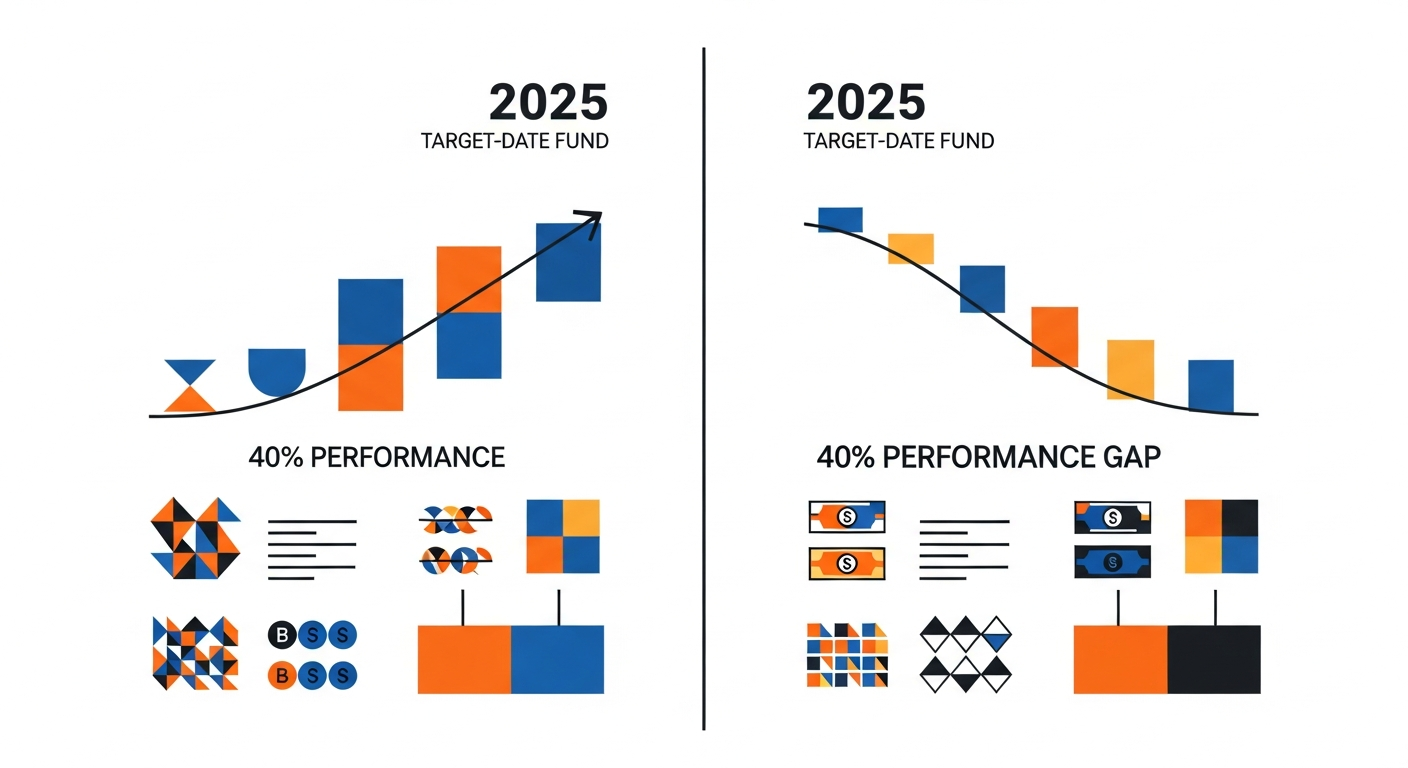
Most investors think they're buying the same thing when they choose a target date fund—but two people who bought 2025 target date funds 15 years ago could have 40% different returns today. Same target year, wildly different outcomes. The culprit? Fund families structure these "simple" investments in dramatically different ways, and most investors never look under the hood.

Key Topics Discussed

Passive Investing vs Active Financial Planning (00:03:30) Cody explains why you should be a passive investor but an active financial planner in your own life, noting that 95% of active investors underperform broad index funds over time.

Understanding Target Date Funds (00:08:15) How target date funds work as default 401(k) options, automatically shifting from aggressive to conservative allocations as retirement approaches along a predetermined glide path.

Surprising Differences Between Target Date Funds (00:18:45) The revelation that identical retirement target years can produce vastly different outcomes depending on fund family—differences in international exposure, bond types, and allocation strategies compound over time.

Comparing Fidelity, Schwab, and Vanguard Target Dates (00:24:00) Detailed breakdown of how three major fund families structure their target date index funds differently, with varying philosophies on diversification and risk management.

The Hidden Costs of Target Date Funds (00:32:20) Analysis showing target date index funds cost 35% to 400% more than purchasing underlying index funds directly. Fidelity's target date index fund, for example, is four times more expensive than buying Fidelity's component funds separately.

Static Allocation Funds Explained (00:38:10) Introduction to balanced funds that maintain constant allocations (like 60/40 stocks/bonds) regardless of your age or proximity to retirement.

Target Maturity vs Constant Maturity Bond Funds (00:42:30) Deep dive into how target maturity bond funds differ from traditional bond index funds—all bonds mature in the same year, converting to cash automatically without requiring you to sell anything.

The Seven-Year Bond Strategy (00:48:15) Cody's approach to determining bond allocation: calculate seven years of planned spending and hold that percentage in bonds. If you'll withdraw $40,000 annually from a $1 million portfolio, hold 28% in bonds ($280,000) and 72% in stocks.

Bond Ladders and Behavioral Finance (00:55:00) How target maturity bond funds overcome psychological barriers to spending in retirement by eliminating the need to "sell" assets—bonds simply mature into cash when you need it.

Simplicity vs Complexity in Portfolio Design (01:02:30) Cody shares his personal eight-fund retirement portfolio strategy, explaining why something that appears complex can actually feel simpler from a behavioral perspective.

Notable Quotes

Mike Piper, CPA (quoted by Cody Garrett, CFP®): "There is no perfect portfolio, but there are countless perfectly fine portfolios."

Rick Ferri, CFA (quoted by Cody Garrett, CFP®): "The perfect portfolio is the one you're going to stick with. Maintaining discipline is the hardest part of investing."

FI Calculator

Travel Tools

Podcast

Local Groups

Forums

Book Club

Value Matrix

Debt Payoff

Workout Logger

Events

FI Calculator

Travel Tools

Podcast

Local Groups

Forums

Book Club

Value Matrix

Debt Payoff

Workout Logger

Events

FI Calculator

Travel Tools

Podcast

Local Groups

Forums

Book Club

Value Matrix

Debt Payoff

Workout Logger

Events

FI Calculator

Travel Tools

Podcast

Local Groups

Forums

Book Club

Value Matrix

Debt Payoff

Workout Logger

Events

Join 25,000+ on the Path to FI

Free access to FI tools, forums, local groups, and 750+ episodes.

No password needed. Free forever.

Cody Garrett, CFP®: "Once you understand what a target date fund is, you no longer need one."

Cody Garrett, CFP®: "Investing is like a bar of soap. The more you touch it, the less there is."

Brad Barrett: "Success in personal finance and investing comes down more to behavior, vastly more to behavior than it comes down to any type of knowledge or intelligence."

Key Takeaways

  • Review your 401(k) fund lineup and sort by expense ratio to identify the lowest-cost index fund options available to you
  • If your 401(k) lacks low-cost index funds (under 0.10% expense ratio), contact your plan administrator to request they be added to the fund lineup
  • Calculate how much money you plan to spend from your portfolio over the next seven years to determine your appropriate bond allocation
  • Visit Morningstar.com and review the portfolio tab of any target date funds you currently own to understand their underlying holdings and allocation strategy
  • Download Cody's 10-question portfolio design exercise at measuretwicemoney.com/ChooseFI to create a strategy you can stick with long-term
  • Consider whether target maturity bond funds might help you overcome psychological barriers to spending in retirement
  • Review your current investments to ensure you're not paying 2-4x more for a target date fund when you could purchase underlying index funds directly

Website

Book

Morningstar.com for fund research and portfolio analysis

ChooseFI Episode 556 with Rachel Camp, CFP®

ChooseFI Episode 194 with Frank Vasquez on the role of bonds

Oblivious Investor blog by Mike Piper, CPA

Bogleheads community

Vanguard Total World Stock ETF (VT), Vanguard Total Stock Market ETF (VTI), Vanguard Total Bond Market ETF (BND)

iShares iBonds, Invesco BulletShares, Vanguard Bond Builder Target Maturity ETFs, State Street My Income ETFs

FI Calculator

Travel Tools

Podcast

Local Groups

Forums

Book Club

Value Matrix

Debt Payoff

Workout Logger

Events

FI Calculator

Travel Tools

Podcast

Local Groups

Forums

Book Club

Value Matrix

Debt Payoff

Workout Logger

Events

FI Calculator

Travel Tools

Podcast

Local Groups

Forums

Book Club

Value Matrix

Debt Payoff

Workout Logger

Events

FI Calculator

Travel Tools

Podcast

Local Groups

Forums

Book Club

Value Matrix

Debt Payoff

Workout Logger

Events

Join 25,000+ on the Path to FI

Free access to FI tools, forums, local groups, and 750+ episodes.

No password needed. Free forever.

Top Travel Card

Ready to unlock a world of free travel? Start with the Chase Sapphire Preferred® Card

$95 annual fee | Earn 100,000 bonus points
Best Card for Side Hustlers and Business Owners

Side hustlers! With the Ink Business Preferred® Credit Card you can earn free travel from your business expenses.

$95 annual fee | Earn 100,000 bonus points

Most Flexible Travel Card

The Capital One Venture Rewards Credit Card can be used to offset almost any travel expense.

$95 annual fee | Earn 75,000 Miles once you spend $4,000 on purchases within 3 months from account opening

ChooseFI has partnered with CardRatings for our coverage of credit card products. ChooseFI and CardRatings may receive a commission from card issuers.


How Fast Could You Reach FI?

Your savings rate is the single biggest factor. Find out exactly where you stand — free, in 60 seconds.

Savings Rate → Years to FI

10%
51 yrs
25%
32 yrs
50%
17 yrs
65%
10.5 yrs

Every 5% increase in savings rate can shave years off your timeline

Free forever — no credit card required

Read Transcript
FREE FI CALCULATOR

What's Your FI Number?

Our free calculator shows you in 60 seconds — create a free account to get started.

60-Second Calculator Your Freedom Date Progress Tracking

Free forever — no credit card required

Comments (11)

Your comment will be posted after signing in
dpark3 1 day ago

I'm confused about the 8 fund approach (1 global equities and 7 bond ladders that mature each year). Year 1, you use the bond bucket #1, but don't you have to liquidate some of the equities to set up bond bucket #8? Cuz if not, 7 years later, you're out of bonds that mature and if that lines up w a crash, you can't set up the next 7 bond buckets without selling at a big dip? So then you're still exposed to the equity volatility every single year since you're selling to buy bonds… help me if I'm not understanding correctly.

1
newfi25 1 day ago

My opinion is bond ladders are silly. People like them because they don't "lose" principal, even though the value of their bonds actually does fluctuate just the same until they mature. Bond funds do the same thing essentially if you keep them for their stated duration. Way less hassle.

1
BostonFI 1 day ago

Yes, you would need to sell shares of another asset each time you want to create another rung of the bond ladder. That's why a bond ladder is really just a psychological crutch and not a magic lever you can pull to avoid selling investments. There's a lot of good discussion about this in the comments.

The best practice is to treat cash/short term bonds like any other asset. Assign an allocation to it (under 10% to protect the long-term growth of your overall portfolio) then naively rebalance your portfolio as needed.

ATreth 2 days ago

Thank you, Cody, for running the numbers comparing long-term returns for the different Target Date funds. So interesting - the big difference in returns! Not super surprising because, like you mentioned, they might be all using the same ingredients, but with a different recipe. But the amount of variance is pretty wild! Thanks again to Brad and Cody for so generously sharing your expertise.

susannz 2 days ago

One of the biggest misconceptions I see is that people assume a target date fund is a standardized product—it’s not. The target year is just the label the underlying asset allocation, international exposure, bond strategy, glide path, and fees can vary dramatically between fund families.

The bigger lesson isn’t that target date funds are “good” or “bad.” It’s that investors should understand what they own instead of relying on the name alone. For many people, a low-cost target date fund is still a perfectly reasonable choice. For others, building the portfolio yourself may provide more control and lower costs.

Behavior will always matter more than finding the “perfect” portfolio. But knowing what’s under the hood helps you stick with your strategy when markets get rough.

One thing worth adding is that there are AI tools available now that can help investors analyze markets, compare investments, identify potential opportunities, and even assist with trade planning. They’re not crystal balls and they don’t guarantee the best trade, but they can be valuable decision-support tools when combined with solid investing principles and risk management. AI should enhance your judgment—not replace it.

Curious… how many people have actually looked inside their target date fund instead of just picking the year closest to retirement?

1
CBRRY 3 days ago

I just went in to take my Vanguard 529s out of Target-Date funds and reallocate to the underlying funds, however before submitting, I double checked the fees. The underlying funds expense ratio was actually right on par with the Target-Date expense ratio. Outside of a 529, the expense ratios were between 0.01 and 0.03, but inside they are 0.1 more. Am I missing something?

BostonFI 2 days ago

That 0.1% extra is the program management and administration fees charged for the 529 plan itself. That fee may be split between the account custodian (Vanguard) and the state agency that administers the 529 plan.

Henry 5 days ago

I just listened to the episode.

Oh Cody, Uncle Frank is going to be so mad at you for plugging a bucket strategy. 😄

2
BostonFI 5 days ago

😅 The target audiences for RPR and CFI really don't overlap all that much. CFI is DIY levels 1-3 and RPR takes over from there with levels 3-4 (RPR E513). I do think this is fine and good. We don't start learning math with discrete mathematics, we start with the basics and build from there. Plus I see plenty of member posts from level 3 investors recognizing the limits of level 3 and looking for what to learn next. So people who graduate from CFI get funneled into RPR.

BUT I do struggle to understand why advisors insist on promoting psychological tricks instead of just educating on best practices. A bond ladder is just an allocation to bonds, but made complicated! Each year you're forced to ask yourself, "what do I do if this a bad year to buy another rung?", instead of just naively rebalancing then going about your life. I think this fact is proven out by the comments in this thread asking exactly that.

I guess I do understand why this is—advisors are running a business and need to give customers what they want and what they want is a sense of security. Techniques like buckets and bond ladders provide that. This does mean though that a level 3 investor needs to unlearn some things to move to level 4.

1
ntmeharg 6 days ago

I was somewhat challenged at first. I liked the "simplicity" of vanguard target date fund but I didn't really like the glide path. I just want a 90/10 split. So after processing and researching I just made a decision which will actually make it simpler for me and I'll just rebalance on my birthday. Thanks for the challenge!

1
ames100 1 week ago

Thanks for the great episode Brad and Cody! One question for Cody: if I decide to build a bond ladder to fund the next 7 years of spending, what happens two or three years in? Is it a rolling 7-year timeframe, so that each year as the one-year bond (or bond fund) matures, I'm investing in a new 7-year fund to keep the time horizon at 7 years? If not, it seems like when I reach year 7, I won't have any more cash coming in. But you framed this as a strategy to avoid having to sell equities in a market downturn, so I'm trying to figure out how I could keep this going without selling some equities to fund the bond ladder going forward. Thanks so much for helping me understand this concept!

6
mslaceyjune 6 days ago

Wondering the same.

I assume in a “normal” year where stocks are up you’d sell stocks to buy another bond fund 7 years out. In a stocks down year you wouldn’t sell, hoping that the stocks recover and you carry on before you burn through all 7 years of bonds.Would love to hear if that’s Cody Garrett, CFP®@Cody Garrett, CFP® ‘s vision! This almost makes it a more simplified version of rebalancing yearly with a regular 80/20 style portfolio.

2
Traveller830FI 6 days ago

Right, this a core mathematical/logic problem with all Ladder/Bucket strategies…. Refilling Bucket #2 inevitably means selling equities at WHATEVER price they're at. In a stable burn rate, Year 7 funds are just time-waiting 1st year Bonds. This very well would mean selling Equities (unnecessarily) in a down market. It very much appears to be a psychological crutch vs a meaningful portfolio diversification (or higher Safe Withdrawal Rate) strategy. Happy to hear how I'm missing the math.

Conversely, doing the math to determine how much spending would be done from the portfolio in the next 5-7 years, determining your portfolio allocation to a Bond fund holding Bonds of that average-year duration. Then, you spend whatever in your portfolio is "overweight" to target allocation. If Equities are up (they usually are), then that's what you liquidate, hold on the Bonds. If Equities plummet more than Bonds, sure, then you liquidate Bonds.

2 2
delfi 5 days ago

so I'm trying to figure out how I could keep this going without selling some equities to fund the bond ladder going forward.

This part sounds like "I want money coming in without selling stocks in retirement". A very real part of the plan underlying things like "the 4% guideline" et. al. is selling stocks over time to fund your lifestyle!

1
HollyG 1 week ago

Another great episode with Cody. Thanks for pointing out not all Target date funds are the same, they have different strategies between companies. That is eye opening and would be interesting to see what all the funds Cody compared.

Plus since they rebalance on their own capital gains can be created within the fund and if you hold it in a taxable brokerage account you pay those capital gains even if you don't sell anything yourself. We experienced this with a family member having active managed funds that created capital gains at the end of the year and didn't see those capital gains until December so no tax planning could occur a small amount invested wouldn't be a problem but if most of your taxable brokerage account is over time more would be.

Lastly learning about the Target maturity bond ETFs I hadn't heard of these which is combine the defined endpoint of an individual bond with the diversification of an ETF. They hold bonds maturing in a specific year, pay monthly income, and liquidate at target maturity to return your principal. Doing a search this is interesting especially if you want a bucket strategy or a short term plan. I could see this for retirement accounts since it would be income taxed in a taxable brokerage account so not tax efficient. Interesting thought.

Thanks Cody and Brad!

1
rcost300 1 week ago

Another great episode, I love the ChooseFI deep dive episodes. Like Brad I also struggled with the idea that the fixed-allocation fund kicks out capital gains at year end due to the rebalancing that happens throughout the year, and there's nothing you can do about it. But if you were to buy the constituent funds independently and rebalance them yourself, you'd end up realizing a similar amount of capital gains. The only way to avoid it would be to not rebalance, and let the portfolio drift off its target allocation - to me, that's not worth it. The fact that I don't have to think about rebalancing (and am not tempted to time the market when doing so) is the biggest advantage of the fixed-allocation fund for me, and I figure the capital gain is what I'd pay anyway.

1 1
Traveller830FI 6 days ago

Rebalancing takes a total of 15 minutes, using a reusable spreadsheet where current holdings are downloaded and dropped into the "input" side. That's the total time to leisurely login, download, paste, transact.

Shannon's Demon is real.

2
BethC 1 week ago

I love that Cody talked about using CBT and motivational interviewing to manage the emotional side of finances. As a mental health counselor, I agree these techniques can be very helpful.

1
Kat_B 1 week ago

This was an interesting and helpful episode. Thank you Cody and Brad!

Join the Conversation

Create an account or sign in to post a comment.

Username
Email

No password needed. We'll send a verification email.

Email
Password

Find Your FI Number

Calculate how much you need — takes 60 seconds.

What's Your FI Number? Find out in 60 seconds

Join ChooseFI

Start your financial independence journey

  • Access to the ChooseFI community
  • Exclusive FI resources and tools
  • Weekly actionable insights
or

No password needed — we'll email you a verification link.

Already have an account?

Don't have an account?

Try searching for

⌘K to open anytime

Your FI Journey

1/3

Step 1 of 3

How familiar are you with Financial Independence?